Friday, February 17, 2012

Live Panda Cam (China): Pandas International Panda Reserves "Endangered means we have time — Extinction is forever."


China Panda Live Camera Endangered means we have time — Extinction is forever.

Panda Reserves in China
The Giant Panda, one of the most delightful and captivating of animals, is also one of the most endangered. The best scientific estimates place the number of wild pandas at approximately 1,600.

In 1999, after a trip to China and the Wolong Panda Center, the sight and plight of the Giant Panda made such a dramatic impression on Suzanne Braden and Diane Rees that upon returning to the United States, they co-founded Pandas International to help save this magnificent animal. In 2000, tax exempt status was granted by the Internal Revenue Service and Pandas International became a registered 501 (c) (3) non profit.

Pandas International is unique in that it is exclusively devoted to the Giant Panda, unlike other organizations, which serve many animals.


As the Director of Pandas International, Ms. Braden coordinates both the annual and immediate needs of the Panda Centers. The personal relationships she has developed with Chinese officials, veterinarians and their staff members have allowed Pandas International to maximize its role in preserving this beloved species. Following the 2008 earthquake which destroyed the Wolong Panda Center and damaged the bamboo forest in the Nature Reserve, the challenge to save the Giant Panda has been made more difficult.  Without intervention, this species could perish.

Mission Statement:
The mission of Pandas International, a non profit organization, is to ensure the preservation and propagation of the endangered Giant Panda by providing public awareness and education, research funding, habitat preservation and enhancement, and assistance to the China Conservation & Research Centers for the Giant Panda (CCRCGP).


Thursday, February 2, 2012

NASA Earth Observatory Mayan Land Use Map + Mayan Earth Mother Video and Tz'utujil Mayan Indigenous Art of Guatemala

View: NASA Earth Observatory Maps of Mayan Land Use from year 800 to year 2000 in Central America. It is difficult to imagine the ancient cities of Central America without associating them with dense tropical forest. But the cultures that built towering stone temples also had to feed 19 million people. As these maps show, most of the land in ancient Central America was cleared, with very little old-growth forest intact.


The maps are a reconstruction of forest extent at three different points: 800-950 A.D., the peak of Mayan culture (top); 1500-1650 A.D., the European colonial period (center); and 2000, modern conditions (bottom). Dark green areas show where tropical forests grew undisturbed. Lighter shades of green mark areas where some of the forest was cleared for agriculture and settlement. White indicates places where people removed all or nearly all of the forest.


The Mayan Art shown here is by Lorenzo Cruz Sunu, Mario Gonzalez,  Marlon Puac, Josè Reanda Quiejù please see below for the story. 

Tz'utujil Mayan Indigenous Art of Guatemala
The Mayan community of San Pedro la Laguna is located in Solola, Guatemala. 10% of the Mayan Sacred Painting profits go to support Mayan children's education and school supplies. All arts and crafts handmade from the 
sacred Mayan Calendar Nawal Nahuales glyph are created in the village by Mayan women who are widowed or single mothers. 70% of profits from the sale of the sacred Mayan Calendar Nawal Nahuales glyph arts and crafts go to the Mayan women craft artisans.

Artist Statement: Lorenzo Cruz Sunu
"I was born in a beautiful town on the shores of Lake Atitlán. I'm the second of eight children and our mother tongue is Tz'utujil. My father is a farmer and my mother is a homemaker – neither had an inclination for art. But from the time I was a child, I felt a great love for colors and designs. It was exciting to go to school, because I loved to draw and art was my favorite class. When I was 11, I told my father I wanted to learn to paint and asked for permission to take classes. But he laughed and didn't take me seriously. I felt so sad, but anyway, I kept on drawing and painting at home when I had a free moment. "


"Today, I understand, because our economic situation was very difficult in those days and extra classes outside the school day weren't a priority for us. By the time I was, 15, several years had passed and I continued drawing and painting with the same dedication. My father decided to support me. With great effort, my parents sent me to Guatemala City to study in the School of Fine Arts. There I discovered my love, passion and vocation for painting. With every passing day, I learned new techniques and, to help my parents, I began to sell my paintings for a few quetzals.
In the School of Fine Arts, I began to meet a number of people who helped me on this road of learning. I've also had the help of my older brother, Pedro Cruz, who helps promote my work and that of other artists in national and international galleries. And, of course, I have the support of my wife."


"I've been working as an artist since 2001, and have exhibited my paintings in places such as Canada, Minnesota, Washington D.C., Maryland and Delaware. I've learned a lot from each exhibit and this motivates me to achieve my dream of sharing the colors and characteristics of my people with the world. My paintings are related with everything I see around me, with what I've learned from my grandparents and their culture. In each work, I try to convey the folklore, the reality of our customs and the legacy of our ancestors. I hope that when you see and acquire my work, you can feel my love and respect for our culture and the people of my homeland."

Mayan Art sales contact Pedro Arnoldo Cruz Sunu on FACEBOOK

Earth Mother Video Video: Saludo a las Madres de Pedro Arnoldo Cruz Sunu

Night Ceremony and Cofrades Lorenzo Cruz Sunu


Friday, January 27, 2012

Videos: Human Wingsuit Base Jumping "Flight Over China" and other videos


Blue suit: Mattt Gerdes 
Air to air camera by Barry Holubeck
Music: "White on White" by Fredrik


Video: Sense of Flying (human wingsuit BASE jump over Norway)


 Watch "Sense of Flying" (5:37, 2011) What is it like flying down a mountain at 250 km/h?  Watch, Espen Fadnes, "The World's Fastest Flying Human Being 2010" soar like a bird, or at least attempt to fly like a bird.

Website" Groovinn
Credits:
Film by: Stavfel Produktion, Goovinn and Espen Fadnes
Idea: Espen Fadnes, Paul Göransson and Lars Idmyr
Wingsuiting: Espen Fadnes
Cameras: Carl Johan Engberg, Paul Göransson, Espen Fadnes, Lars Idmyr and Kjersti Eide


Tuesday, January 24, 2012

Video/Photo of NASA Space Weather by Solar Heliospheric Observatory (Sun Storms, Solar Flares, Solar Coronal Mass Ejections plus 2013 Solar Maximum)


The images above show a solar flare 
as observed by the Atmospheric Imaging Assembly (AIA) 
Videos and Photos of 2013 Space Weather actuals and predictions for Sun Storms, Solar Flares, Solar Coronal Mass Ejections and more..

Space Weather including solar flares and CMEs are not a danger to humans on Earth's surface, as the planet's magnetic field (magnetosphere) and atmosphere deflect and absorb the solar energy and particles. The sun storms can pose some risks to astronauts, and they can upset the electronics and transmissions on science, military, and communications satellites. Closer to Earth's surface, solar activity can cause disruptions of radio signals (particularly HF), provide a small dose of radiation to passengers on high-latitude flights, and provoke auroras (northern and southern lights).

Note the brightening of the solar surface as gas was superheated and magnetically supercharged. By the third (right) image, a stream of solar material is seen flowing off into space above the hot spot, likely solar protons and a coronal mass ejection. Click on the enlarged images and movies for a wider view.


Solar Flare Radiation 'Snow' Photo Credit: SOHO/ESA and NASA

Fast-moving protons from a solar energetic particle (SEP) event cause interference that looks like snow in these images from the Solar Heliospheric Observatory taken on January 23, 2012.

Monday, January 23, 2012

Video: Film "Blue Gold" and Link TV Interview with Tsilhqot'in and Xeni Gwet'in People of British Columbia on the proposed copper and gold mining project of "Fish Lake" "Teztan Biny" by Taseko Mines


Interview with the Tsilhqot'in and Xeni Gwet'in people of British Columbia, Canada featuring the film Blue Gold made by Canadian filmmaker Susan Smitten (R.A.V.E.N.) and her team to document the impact of the proposed copper and gold mine by Taseko Mines on the environment and cultural heritage of "Fish Lake" "Teztan Biny" and the native people of British Columbia.


Wednesday, January 4, 2012

Space Video "Gateway to Astronaut Photography of Earth - Crew Videos" and NASA/ISS Video of LoveJoy Comet


In November and December 2011, professional and amateur astronomers revelled in observing a sun-grazing comet that dove close to the Sun and survived for a return flight back to the outer solar system. Astronauts on the International Space Station (ISS) enjoyed their own surreal view of the comet as it appeared on Earth’s horizon on the day of the solstice.
ISS Commander Dan Burbank captured a series of digital photographs of Comet Lovejoy on December 21, 2011, as it rose above Earth’s limb. Note how the tail of the comet points away from the Sun even as the comet itself is moving in the same direction, away from our star. Every comet has two tails, one of ice and dust, the other of ions, or charged particles. The heat and pressure of sunlight sloughs off the ice and dust, pushing it away from the Sun. Likewise, the solar wind strips ions off of the comet surface, though not necessarily in the same direction as the tail of debris and ice. The ion tail is not visible in this image.
The comet, officially designated C/2011 W3 (Lovejoy), was discovered by Australian amateur astronomer Terry Lovejoy on November 27, 2011. It belongs to a group of comets known as the Kreutz sungrazers, which are thought to be pieces of a much larger comet that broke up centuries ago. The comets are termed sungrazers because their orbits take them quite near—and often into—the Sun.
Comet Lovejoy is remarkable for diving through the superheated solar corona (atmosphere) to within 120,000 kilometers of the Sun’s surface and surviving the encounter. The event was recorded by five NASA and European spacecraft.
In the ISS image above, you can also see green and yellow airglow paralleling the Earth’s horizon line (or limb) before it is overwhelmed by the light of the rising Sun. Airglow is the emission of light by atoms and molecules in the upper atmosphere after they are excited by ultraviolet radiation. In the video, small intermittent flashes of white lightning discharges also are visible over Earth’s surface.
Astronaut photograph ISS030-E-015491 was acquired on December 22, 2011, with a Nikon digital camera, and is provided by the ISS Crew Earth Observations experiment and Image Science & Analysis Laboratory, Johnson Space Center. The image was taken by the Expedition 30 crew. The image has been cropped and enhanced to improve contrast. Lens artifacts have been removed. The International Space Station Program supports the laboratory as part of the ISS National Lab to help astronauts take pictures of Earth that will be of the greatest value to scientists and the public, and to make those images freely available on the Internet. Additional images taken by astronauts and cosmonauts can be viewed at the NASA/JSC Gateway to Astronaut Photography of Earth by Michael Carlowicz, NASA Earth Observatory, and Melissa Dawson and William L. Stefanov, Jacobs/ESCG at NASA-JSC at NASA-JSC.


Mayan Tz'utujil Arte Indigenous Painting, Art and Craft Cooperative: Single Mayan Mothers Create To Teach Mayan History, and Raise Money For Their Children's "Mayan Education Fund"


Lake Atitlán, San Pedro la Laguna in Solola, Guatemala. Profits from selling the Mayan Sacred Paintings go to support Mayan children's education and school supplies. Profits from selling arts and crafts depicting the sacred Mayan Calendar Nawal Nahuales glyphs, go direct to the Mayan Mother Craft Artisans and their children. 

For information on the Mayan Art shown on this page by Lorenzo Cruz Sunu, Mario Gonzalez, Marlon Puac, and Josè Reanda Quiejù please contact Pedro Arnoldo Cruz Sunu. Pedro's Contact Pedro's LinkedIn  and
Pedro's FACEBOOK for sales or for more information about the Fair Trade and Artisan Profit Program to support continually creating and selling  Tz'utujil Mayan Indigenous Art of Guatemala.

Pedro expresses "Maltiox". Mayan Tz'utujil language for Thank You, to everyone who has shown interest in the Mayans and their ancestry. "Thank you very much for understanding and making Mayan Tz'utujil Indigenous Art very spiritual - for our sacred works that come from the lives of our ancestors, the works reflect insipid to us all the culture that our ancestors have left us. I feel very proud."

The artist below Lorenzo Cruz Sunu's FACEBOOK page link ~ please visit and encourage him.

Video Salute to Mother Earth by Pedro Arnoldo Cruz Sunu
Video Saludo a las Madres de Pedro Arnoldo Cruz Sunu

The women and men hold bundles of maize (corn), wildflowers and candles. They wear the colorful handloomed clothing of the region. Artist Lorenzo Cruz Sunu explains, "The colors of the corn symbolize the four cardinal directions to the Maya. White represents north, yellow is south, black is for west and red is east. The candles symbolize the four ethnic groups of Guatemala – the Maya, Garífunas, Xincas and Ladinos. For me, this painting is more than something pretty. It has a meaning, and this symbolism was my inspiration."


Artist Statement of Lorenzo Cruz Sunu

"I was born in a beautiful town on the shores of Lake Atitlán. I'm the second of eight children and our mother tongue is Tz'utujil. My father is a farmer and my mother is a homemaker – neither had an inclination for art. But from the time I was a child, I felt a great love for colors and designs."


 "It was exciting to go to school, because I loved to draw and art was my favorite class. When I was 11, I told my father I wanted to learn to paint and asked for permission to take classes. But he laughed and didn't take me seriously. I felt so sad, but anyway, I kept on drawing and painting at home when I had a free moment. Today, I understand, because our economic situation was very difficult in those days and extra classes outside the school day weren't a priority for us."

"By the time I was, 15, several years had passed and I continued drawing and painting with the same dedication. My father decided to support me. With great effort, my parents sent me to Guatemala City to study in the School of Fine Arts. There I discovered my love, passion and vocation for painting. With every passing day, I learned new techniques and, to help my parents, I began to sell my paintings for a few quetzals. In the School of Fine Arts, I began to meet a number of people who helped me on this road of learning. I've also had the help of my older brother, Pedro Cruz Sunu, who helps promote my work and that of other artists in national and international galleries. And, of course, I have the support of my wife."

"I've been working as an artist since 2001, and have exhibited my paintings in places such as Canada, Minnesota, Washington D.C., Maryland and Delaware. I've learned a lot from each exhibit and this motivates me to achieve my dream of sharing the colors and characteristics of my people with the world.

"My paintings are related with everything I see around me, with what I've learned from my grandparents and their culture. In each work, I try to convey the folklore, the reality of our customs and the legacy of our ancestors. I hope that when you see and acquire my work, you can feel my love and respect for our culture and the people of my homeland."

Tuesday, January 3, 2012

Galactic Navigation Chandra Sky Map Tour ~ Explore Space Photo Album and Videos of The X-Ray Sky with Galactic Coordinate System (photos and animations inside Black Holes)


Chandra Photo Album with photos of Black Holes and animations inside Black Holes

Since its launch on July 23, 1999, the Chandra X-ray Observatory has been NASA's flagship mission for X-ray astronomy, taking its place in the fleet of "Great Observatories."

NASA's Chandra X-ray Observatory is a telescope specially designed to detect X-ray emission from very hot regions of the Universe such as exploded stars, clusters of galaxies, and matter around black holes. Because X-rays are absorbed by Earth's atmosphere, Chandra must orbit above it, up to an altitude of 139,000 km (86,500 mi) in space. The Smithsonian's Astrophysical Observatory in Cambridge, MA, hosts the Chandra X-ray Center which operates the satellite, processes the data, and distributes it to scientists around the world for analysis. The Center maintains an extensive public web site about the science results and an education program.

Chandra carries four very sensitive mirrors nested inside each other. The energetic X-rays strike the insides of the hollow shells and are focussed onto electronic detectors at the end of the 9.2- m (30-ft.) optical bench. Depending on which detector is used, very detailed images or spectra of the cosmic source can be made and analyzed.

Chandra has imaged the spectacular, glowing remains of exploded stars, and taken spectra showing the dispersal of elements. Chandra has observed the region around the supermassive black hole in the center of our Milky Way, and found black holes across the Universe. Chandra has traced the separation of dark matter from normal matter in the collision of galaxies in a cluster and is contributing to both dark matter and dark energy studies. As its mission continues, Chandra will continue to discover startling new science about our high-energy Universe.


Wednesday, December 21, 2011

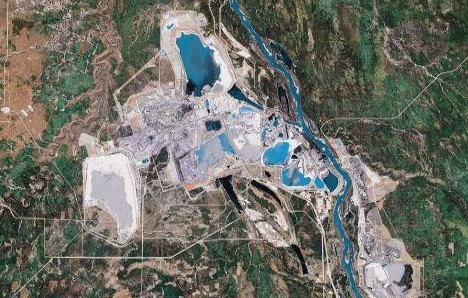
Photo NASA Earth Observatory ~ Athabasca (Alberta) Oil Sands growth 1984 to 2011


The Beaver Lake Cree, a small, impoverished band of 900 people in eastern Alberta, are suing the Canadian federal and Alberta provincial governments to protect the land. They claim that Alberta's tar sands developments are obliterating their traditional hunting and fishing lands in Alberta. The animals, fish, plants and medicine that sustain the Beaver Lake Cree are being destroyed. In Canada, the rights of Indigenous people are constitutionally protected. The Beaver Lake Cree’s Statement of Claim cites more than 17,000 infringements on their treaty rights and in the course of doing so names every major oil company in the world.
Investment in the bituminous sands in northern Alberta – the world’s last great oil field – totals approximately $200 billion. No assessment of the cumulative environmental or cultural damage has been done. It has been argued that this project – unhindered – will destroy a large part of the great boreal forest of North America, will escalate global warming, and will destroy an indigenous way of life. The Alberta government continues to approve projects, such that production of dirty oil will increase from the current 1.3 million barrels per day to 3 million barrels per day.

Already vast expanses of the boreal forest have been cut down – causing significant damage to the environment and to the earth’s well-being. The forest is home to a long list of animals, from black bears, caribou, marten, moose. As the forest is eroded to make way for open mines and in-situ mines, the ‘great lung’ of North America with its rich carbon-storing peat and soil, is disappearing. In its place, rapid growth of carbon emissions threatens to increase the earth’s temperature. Meanwhile, oil sands extraction pollutes the earth with its tailings ponds, pollutes the air with its emissions, and pollutes the water using two to four barrels of water to produce just one barrel of bitumen and creating vast lakes of chemicals that leach into local watersheds.


Thursday, December 15, 2011

Peace Video Tour of the University For Peace, Universidad para la Paz Costa Rica


Video Tour ~ headquartered in Costa Rica, the United Nations-mandated University for Peace was established in December 1980 as a Treaty Organization by the UN General Assembly. As determined in the Charter of the University, the mission of the University for Peace is: “to provide humanity with an international institution of higher education for peace with the aim of promoting among all human beings the spirit of understanding, tolerance and peaceful coexistence, to stimulate cooperation among peoples and to help lessen obstacles and threats to world peace and progress, in keeping with the noble aspirations proclaimed in the Charter of the United Nations.” Video explaining charter click here

To ensure academic freedom, the University was established under its own Charter, approved by the General Assembly. UPEACE is not subject to UN regulations and is directed by its own Council of renowned personalities with expertise in peace and security matters. This has allowed the University to move rapidly and to innovate, focusing its new, rigorous academic programme on the fundamental causes of conflict through a multidisciplinary, multicultural-oriented approach.

The wider mission of the University should be seen in the context of the worldwide peace and security objectives of the United Nations. The central importance of education, training and research in all their aspects to build the foundations of peace and progress and to reduce the prejudice and hatred on which violence, conflict and terrorism are based is increasingly recognized. The Charter of the University calls for UPEACE “to contribute to the great universal task of educating for peace by engaging in teaching, research, post-graduate training and dissemination of knowledge fundamental to the full development of the human person and societies through the interdisciplinary study of all matters related to peace”.

Funding of UPEACE programmes comes from the support of a number of donor governments, foundations and institutions who believe in the mission of the University. Fundraising for an endowment fund is in progress.

The vision of UPEACE is to become a network of collaborating UPEACE centres and activities in different regions, guided from its headquarters in Costa Rica and cooperating with a large number of universities, NGOs and other partners on education and research for peace.


Wednesday, December 14, 2011

Video "Standing on Sacred Ground"


Films and Videos and Blog of photos, behind-the-scenes videos from our shoots and field reports from Producer/Director Christopher (Toby) McLeod. Learn about the peoples of these remarkable places and the battles they are fighting to preserve their lands, waters and ancient ways of life.

After thousands of hours of filming and editing, our final four-part documentary series is emerging, as has a new title that more powerfully reflects the message of the films. In changing the series title from Losing Sacred Ground to Standing on Sacred Ground, we honor the growing international community of sacred site protection advocates, through whom renewed reverence is emerging for sacred landscapes all over the Earth.

Our working title, Losing Sacred Ground, conveyed real urgency, but as we work on the stories, what has come to the forefront is not fear and loss, but determined resistance rooted in sacred places. It is a message of hope and healing. We think this new title conveys the incredible commitment and creativity demonstrated by indigenous communities and their supporters around the world.


To learn more about our work pleae check out our  2011 annual report, and a wonderful letter of support from Bill McKibben. And if you would like to join our community of sacred land defenders, please make a tax-deductible year-end donation to help us complete the series and meet our deadline of releasing the film series in 2012. Thanks again for your support!

A 2005 report by the World Wide Fund for Nature and the Alliance of Religions and Conservation, titled “Beyond Belief,” concluded: “Sacred sites are the oldest method of habitat protection on the planet.” Yet these biological and cultural treasures are under assault — as are the people who have been safeguarding them for millennia. Building on the success of our award-winning PBS documentary, the Sacred Land Film Project (SLFP) is producing a four-part film series for public television titled Standing on Sacred Ground. The series will expose corporate and environmental assaults on indigenous peoples’ sacred landscapes and promote strategies to protect the ecological integrity of these endangered places.

The film will tell eight distinct stories from the viewpoints of diverse indigenous communities — stories that evoke ancient and contemporary spiritual connections to earth, while exploring how the health of our global environment can be sustained through respectful understanding of the sacred lands and traditions of these native peoples.

In making Standing on Sacred Ground, SLFP has filmed cultural landscapes on five continents: the Altai Republic of Russia, Aboriginal Australia, the Andes of Peru, the Rift Valley in Ethiopia, Papua New Guinea, native lands in northern California, the sacred Hawaiian island of Kahoʻolawe, and the oil sand rich boreal forest of Canada.

Now in its fourth year of production, editing is fully underway and the series will be completed in 2012. These documentaries would not be possible without the unique relationships and trust built over decades by the Sacred Land Film Project with native people around the world.


Sunday, December 4, 2011

Music Videos of Golden Age for Peruano Rock : Peru's Retro Classic Rock Music Stars (1950's, 60's 70's)


Videos of retro classic rock music stars of Peru's Golden Age of Rock. Nuevos videos, fotos y artículos sobre la época de oro del rock Peruano.

Video of Rock Peruano (Rollos)

Images - Imagenes
Gallery of images for the Peruvian rock groups of the major epoque of the 60's and 70s.
Estas son galerías de imágenes de los grupos más destacados de la mejor epoca del rock peruano: la década de los 60s y comienzos de los 70s. Este blog debe tomarse como un anexo complementario del blog principal.


Principle blog site for Peruano Rock 1957 - 1972
Words from the blogger Heduardo in San Bartolo, Lima, Peru. Hola, este es un blog dedicado al rock peruano desde el año 1957 hasta mediados de los años setenta. Inicialmente este blog tenía su soporte en los archivos musicales (mp3) que me había tomado el trabajo de subir a IMEEM, en base a los cuales había elaborado Play List de muchos grupos peruanos de los sesentas y comienzos de los setentas. La idea era escribir lo menos posible y compartir con ustedes lo más importante de esos grupos, su música. Como muchos saben, My Space compró IMEEM para luego liquidarlo y todos los mp3 que yo había subido se fueron al diablo. Este fue un trauma para mi, del cual hasta hoy me cuesta recuperarme, pues el sitio que tenía en IMEEM ya había interesado a muchos jóvenes y recibía muchas visitas. Ahora me he propuesto subir todos esos archivos musicales a You Tube para luego ponerlos aquí.

Habrán notado que la intención de este blog es tener buenos anexos de textos (escritos por los que saben), imágenes y ahora videos con la música que estoy subiendo a You Tube. Aparentemente el blog no tiene nuevas entradas pero debo decirles que constantemente lo estoy actualizando con nuevos videos, fotos y artículos sobre la época de oro del rock peruano. Todo lo que encuentro lo subo aquí.

Veo con alegría que otros blogs sobre la primera etapa de nuestro rock están apareciendo, muchos de ellos hechos por jóvenes como ustedes. Esa es la máxima recompensa que puede recibir un tío viejo en años pero mentalmente joven como ustedes. Esta es la música que escucharon sus padres, por lo tanto esta música está en el ADN de ustedes, los hijos. Esta Historia es tu Historia. Estamos en contacto.

Videos Saicos Forever
Just click and watch, self explanatory.