Wednesday, September 7, 2011

Kejimkujil Dark Sky Nature Preserve


Kejimkujik was designated as a Dark Sky Preserve in 2010 by the Royal Astronomical Society of Canada as part of their Dark Sky Preserve Program. As a DSP, Kejimkujik is committed to protecting the nighttime environment from the effects of artificial lighting. Educating visitors about the ecological and cultural importance of dark skies are key elements of the DSP program. The designation is the first in Nova Scotia.

Protecting the dark skyscapes of Kejimkujik benefits stargazers as well as wildlife. Studies have shown that many of the biological and behavioural activities of plants, animals and insects that rely on night darkness to forage, breed and navigate are adversely affected by light pollution.

As a Dark Sky Preserve, Kejimkujik gives present and future generations a chance to gaze upon the same stars seen by the Mik’maq, European explorers, and early settlers. In the summer, Kejimkujik offers public astronomy programs and an interpretation program exploring the significance of the night sky in Mi’kmaw culture and history.


Tuesday, August 23, 2011

Video "LIVE Elephant Cam at The Elephant Sanctuary"


Shirley and Jennie Elephants Reunited After 25 Years

The Elephant Sanctuary in Tennesse
Our Mission: Founded in 1995, is the USA's largest natural habitat refuge developed specifically for endangered African and Asian elephants. The Sanctuary operates on 2,700 acres in Hohenwald, Tennessee — 85 miles southwest of Nashville.

The Elephant Sanctuary exists for two reasons:
- To provide a haven for old, sick or needy elephants in a setting of green pastures,
dense forests, spring-fed ponds and heated barns for cold winter nights.

- To provide education about the crisis facing these social, sensitive, passionately intense,
playful, complex, exceedingly intelligent and endangered creatures.

The Elephant Sanctuary in Hohenwald, Tennessee, is the nation's largest natural-habitat refuge developed specifically to meet the needs of endangered elephants. It is a non-profit organization, licensed by the U.S. Department of Agriculture and the Tennessee Wildlife Resources Agency, and accredited by the Association of Sanctuaries, designed specifically for old, sick or needy elephants who have been retired from zoos and circuses. Utilizing more than 2700 acres, it provides three separate and protected, natural-habitat environments for Asian and African elephants. Our residents are not required to perform or entertain for the public; instead, they are encouraged to live like elephants.

Development of The Elephant Sanctuary's facilities began in March 1995. Phase I includes a heated barn, a 200-acre steel pipe and cable elephant corral, and a 222-acre perimeter "people" fence. Phase II was completed December 1999, adding a 6-stall, 9000 square foot, state-of-the-art elephant barn to the facility. Land expansion began Oct 2001 with the acquisition of a parcel of wilderness known locally as the Highland Lake Land—a 700-acre parcel of land with a 25-acre lake. July 2003 marked the final land acquisition which constitutes our expansion. This 1840–acre parcel of wilderness was owned by International Paper company prior to becoming Elephant Country. This 1840-acres parcel of land was purchased from International Paper Company in order to provide more space for our elephants. Prior to the sale nearly half of the land was clear cut. Our plan is to heal the land from the ravages of this activity by creating seeded pastures in some areas and allowing other sections to regenerate the indigenous forest. Look closely and you will see the 25-acre spring fed lake in the upper left portion of the photos. As far as the eye can see—Asian Elephant Country.

African Elephant Habitat was completed January 2004. This 300-acre facility with its award-winning elephant house is a showcase for innovative solar use. Renovation of the Phase I barn was completed Nov 2004, creating a Quarantine Facility for sick elephants. In September 2005, we completed construction of our new Asian elephant house.

The Elephant Sanctuary in Tennessee is a 501(c)(3) non-profit organization.
The Elephant Sanctuary


Sunday, August 21, 2011

The Universe Video~ Astronomers Unveil Most Complete 3-D Map of Local Universe


Astronomers Unveil Most Complete 3-D Map of Local Universe

Astronomers unveiled the most complete 3-D map of the local universe (out to a distance of 380 million light-years) ever created. Taking more than 10 years to complete, the 2MASS Redshift Survey also is notable for extending closer to the Galactic plane than previous surveys - a region that's generally obscured by dust. The 2MASS Redshift Survey is a complete new look at the local universe - particularly near the Galactic plane. A galaxy's light is redshifted, or stretched to longer wavelengths, by the expansion of the universe. The farther the galaxy, the greater its redshift, so redshift measurements yield galaxy distances - the vital third dimension in a 3-D map. 2MRS chose galaxies to map from images made by the Two-Micron All-SkySurvey (2MASS). This survey scanned the entire sky in three near-infrared wavelength bands. Near-infrared light penetrates intervening dust better than visible light, allowing astronomers to see more of the sky. But without adding redshifts, 2MASS makes only a 2-D image. 


The Universe Video ~ Space Animation Image Gallery of Harvard-Smithsonian Center For Astrophysics

Tuesday, August 9, 2011

Sound Video: Anthony Bourdain: No Reservations - An Acoustic Anomaly "The Integratron"

Anthony Bourdain: No Reservations - An Acoustic Anomaly 
website for Integratron

George Van Tassel, creator of the Integratron, was a legendary figure, an aeronautical engineer and test pilot who worked for Lockheed, Douglas Aircraft and alongside Howard Hughes at Hughes Aviation. Van Tassel was influenced by scientists such as Nikola Tesla, which led to the unique architecture of the "Integratron" - he spent 18 years constructing the building. In 1947, after an exemplary career in aviation, Van Tassel moved his family to Giant Rock in the Mojave Desert near Landers, California and opened Giant Rock Airport and a cafe called The Come On Inn. He leased four square miles of land from the government, including Giant Rock, a 7-story high, freestanding boulder sacred to the Native Americans who lived in the area.

Acoustic-Engineered Domed Roof 
of The Sultan of Zanzibar's Women's Palace Water Bathing Sanctuary

Thursday, August 4, 2011

Abundance Video: Kiva (world wide web micro loans from individuals to individuals)

Kiva
How Kiva Works video Individuals lending money to individuals via the internet.
Who in the world needs a loan?

1) Choose a borrower
All loans on Kiva are deserving of funding. Pick the one that speaks the most to you.

2) Make a loan
Loan amounts can be as little as $25, or as high as the full loan amount. Checkout is quick and easy, made possible by Paypal.

3) Get repaid
As the borrower repays the loan, the money becomes available in your account. This is called your Kiva Credit.

4)Repeat
You can now use it to fund another loan, donate it to Kiva, or withdraw it to spend on something else.

Wednesday, August 3, 2011

Video: TED Talk - Wade Davis on Endangered Cultures

Click here to watch Wade Davis talk about Endangered Cultures 

Anthropologist Wade Davis is perhaps the most articulate and influential western advocate for the world's indigenous cultures. His stunning photographs and evocative stories capture the viewer's imagination. As a speaker, he parlays that sense of wonder into passionate concern over the rate at which cultures and languages are disappearing -- 50 percent of the world's 6,000 languages, he says, are no longer taught to children. 

He argues, in the most beautiful terms, that language is not just a collection of vocabulary and grammatical rules. In fact, "Every language is an old-growth forest of the mind."

Davis, a Harvard-educated ethnobotanist, believes humanity's greatest legacy is the "ethnosphere," the cultural counterpart to the biosphere, and the sum total of all thoughts and dreams, myths, ideas, inspirations, intuitions brought into being by the human imagination since the dawn of consciousness."

He beautifully articulates the intellectual, emotional and moral reasons why it's in everyone's best interest to preserve the world's cultures. To this end, Davis serves on the councils of www.ecotrust.org and other NGOs working to protect diversity. He also co-founded Cultures on the Edge a quarterly online magazine designed to raise awareness of threatened communities. Perhaps his best-known work is The Serpent and the Rainbow, an international bestseller about zombification practices in Haiti. Wes Craven adapted the book into a 1988 film, which Davis denounced as a betrayal of the book's spirit. In 2007, he authored The Clouded Leopard: A Book of Travels and two years later gave a series of lectures which were published into his latest work, The Wayfinders: Why Ancient Wisdom Matters in a Modern World.

His work with indigenous cultures has given him a truly unique view of the world. He is able to slip off the map for awhile, to live with the voodoo priests in Haiti, the Penan in Borneo, or the Quechuen of Chinchero." - CBC-TV

Monday, August 1, 2011

Video: Technology May Soon Turn Thoughts Into Action

Technology May Soon Turn Thoughts Into Action
"If you can imagine it, you can achieve it." An inspirational saying, yes. But prosthetic limbs that amputees may directly control with their brains and that will allow them to feel what they touch? Science fiction?

"There's nothing fictional about this," said Maria O'Malley of Rice University.
O'Malley is one of four principal investigators from four U.S. universities funded by the National Science Foundation embarking on a four-year program to design such prosthetics. Brent Gillespie from the University of Michigan, Jose Contreras-Vidal from the University of Maryland and Patricia Shewokis from Drexel University rounds out the collaborative research team.

"These researchers have developed a unique approach," said NSF Human-centered Computing program manager Ephraim P. Glinert. "The team will build upon their prior work to design and validate non-invasive neural decoders that generate agile control in upper limb prosthetics. This is exciting, and will have broad implications for potentially millions, including many recent war veterans, who face daily challenges associated with prosthetic limbs."

O'Malley agrees. "Researchers have already demonstrated that much of this is possible. What remains is to bring all of it--non-invasive neural decoding, direct brain control and haptic sensory feedback--together in one device."

Contreras-Vidal, who is an associate professor of kinesiology, and his team have created a non-invasive, sensor-lined cap that forms a "brain computer interface" that could control computers, robotic prosthetic limbs, motorized wheelchairs, and even digital avatars. The team has published three major papers on their technology over the past 18 months, the latest a just released study in the Journal of Neurophysiology in which they successfully used EEG brain signals to reconstruct the complex 3-D movements of the ankle, knee and hip joints during human treadmill walking.

In two earlier studies they showed similar results for 3-D hand movement, and they also showed subjects wearing a brain cap could control a computer cursor with their thoughts.

Contreras-Vidal's previously demonstrated technology that allowed test subjects to move a cursor on a computer screen simply by thinking about it. Non-invasively tapping into the user's neural network using a brain cap of electrodes that read electrical activity on the scalp via electroencephalography (EEG) made this discovery possible.

The team plans to combine this EEG information with real-time data about blood-oxygen levels in the user's frontal lobe using functional near-infrared (fNIR) technology developed by Shewokis at Drexel.

Shewokis said, "We want to provide intuitive control over contact tasks, and we're also interested in strengthening the motor imagery the patients are using as they think about what they want the arm to do. Ideally, this tactile, or haptic, feedback will improve the signal from the EEG and fNIR decoder and make it easier for patients to get their prosthetic arms to do exactly what they want them to do. We are moving toward incorporating the 'brain-in-the loop' for prosthetic use and control."

O'Malley said the new technology is a big leap over what's used in existing prosthetic devices, which don't allow amputees to feel what they touch. Some state-of-the-art prostheses today use force-feedback systems that vibrate--much like the 'vibrate' mode on a mobile phone--to provide limited information about objects a prosthetic hand is gripping.

"Often, these vibrotactile cues aren't very helpful," O'Malley said. "Many times, individuals simply rely on visual feedback--watching their prosthesis grasp an object--to infer whether the object is soft or hard, how tightly they are grasping it and the like. There's a lot of room for improvement."

Gillespie said, "This truly unique team has been given the opportunity to help solve the challenging problem of brain-to-machine interface. I'm excited about our breakthroughs and the promise for future results. We are approaching the dilemma with big respect for the brain/body connection and hope to discover methods to harness the body in new ways.

Sensory feedback, especially haptic feedback, is often overlooked, but we think it's the key to closing the loop between the brain and motorized prosthetic devices," he said. "These results indicate that we stand a very good chance to help amputees and also help others who may be suffering from motor impairments."

Glinert is hopeful for even broader impacts, "This research will revolutionize the control and interface of upper limb prosthetics. The work will lead to a better understanding of the role of sensory feedback in brain-computer interfaces and will lay the foundation for restoration of motor and sensory function for amputees and individuals with neurological disease."

Wednesday, July 27, 2011

TED Video: Sixth Sense Technology demo by Pattie Maes and Pranav Mistry

TED video Pattie Maes and Pranav Mistry demo Sixth Sense technology
This demo -- from Pattie Maes' Fluid Interfaces Group at MIT Media Lab, spearheaded by Pranav Mistry -- was the buzz of TED. It's a wearable device with a projector that paves the way for profound interaction with our environment. Imagine the movie "Minority Report" and beyond. Pattie Maes at the MIT Media Lab's new Fluid Interfaces Group, researches the tools we use to work with information and connect with one another. Pranav Mistry is the inventor of SixthSense, a wearable device that enables new interactions between the real world and the world of data.

Friday, July 22, 2011

Music Video ~ Local Natives - Who Knows Who Cares - A Take Away Show (Paris)

Black XS & la Blogotheque go around the world to film bands with live sound on street locations as take away shows. Here is a special series in Paris, France with the band Local Natives filmed before their show at Les Inrockuptibles festival. 
Local Natives | Who Knows Who Cares | A Take Away Show (Paris)
I've been going down
Down into the river baby
Listen to the sound
It's something only god knows
You figure it out, I can't stay
Water's in the clouds
Is my life about to change?
Who knows, who cares

So we took a van down to colorado
Where we ran into the dead
I took you by the hand
Know that even with your doubts, it's ok
Take into account that it's not about to change
Who knows, who cares

You could let it down
Jump into the river baby
Easy as it sounds
It's never quite as easily done
The current has us now, it's ok
Take into account that it's all about to change
Who knows, who cares

No one's been there
But I don't care
I know all have been there
I don't care
I know.

Paris sunset 

Sunday, July 17, 2011

Nature Video by Ancient Forest Alliance ~ Giant Cheewhat Tree on Vancouver Island B.C.

Ancient Forest Alliance ~ Giant Cheewhat Tree  on Vancouver Island, Pacific Rim National Park B.C.. Canada's largest tree, a western redcedar named the Cheewhat Giant growing in a remote location near Cheewhat Lake within Pacific Rim National Park Reserve on southerwestern Vancouver Island. The tree measures over 6 meters (20 feet) in trunk diameter, 56 meters (182 feet) in height, and 450 cubic meters in timber volume (or 450 regular telephone poles worth of wood). Luckily the tree, discovered in 1988, is within the Pacific Rim National Park Reserve, which was created in 1971.

The video clip also shows new clearcuts and giant stumps of red cedar trees, some over 4 meters (14 feet) in diameter in the Klanawa Valley adjacent to Pacific Rim National Park Reserve and also near the Carmanah-Walbran Provincial Park, a short distance to the south.

Satellite photos show that about 75% of the original, productive old-growth forests on Vancouver Island have been logged, including 90% of the valley bottoms where the largest trees grow and most biodiversity is found. On southern Vancouver Island, south of Barkley Sound, about 87% of the original, productive old-growth forests have been logged.

See "before" and "after" old-growth forest maps at:http://www.ancientforestalliance.org/old-growth-maps.php

Visit the Ancient Forest Alliance website athttp://www.ancientforestalliance.org 

Please SIGN our PETITION here: http://www.ancientforestpetition.com


Video: Whale Rescue ~ Saving Valentina documented by Earth Island Institute

Saturday, July 16, 2011

Nature Video ~ Moonbows at Yosemite

Moonbows in Yosemite


A moonbow (also known as a lunar rainbow, white rainbow, lunar bow or space rainbow) is a rainbow produced by light reflected off the surface of the moon rather than from direct sunlight. Moonbows are relatively faint, due to the smaller amount of light reflected from the surface of the moon. They are always in the opposite part of the sky from the moon.

It is difficult for the human eye to discern colors in a moonbow because the light is usually too faint to excite the cone color receptors in human eyes. As a result, they often appear to be white. However, the colors in a moonbow do appear in long exposure photographs.

A true moonbow is lit from the Moon itself. A colored rainbow when the sun is setting or when it is darker out is not a moonbow because it is still produced by sunlight. Moonbows have been mentioned at least since Aristotle, in his Meteorology, circa 350 BC, and in 1847 and the term moonbow was used by Nick Whelan who sighted one of the first documented moonbows in Eastern Utah.

Wednesday, July 6, 2011

Video and photography: "TED Talk of The Beautiful Nano Details of Our World", "Micro Photos of Moon and Earth Sand Grains" by Dr Gary Greenberg


Watch "TED Talk of The Beautiful Nano Details of Our World"

Photo Gallery: Moon Sand and Earth Sand Grain Close-Ups

Watch documentary "A Grain of Sand" by Dr Gary Greenberg

Every grain of sand in the world is unique and beautiful when viewed through the microscope. If each grain of sand is so beautiful and unique, imagine how beautiful and unique each person is? Artist, inventor, and scientist, Dr Gary Greenberg has devoted his life to revealing the secret beauty of nature. Beginning his career as photographer and filmmaker, he worked on the first Superman film where he transformed human pancreatic cancer cells into the planet Kyrpton. After earning a Ph.D. in biomedical research, he went on to invent the high-definition, three-dimensional light microscope, for which he was issued eighteen US patents.


Friday, June 24, 2011

Video short film "Telling Our Stories" by Alanis Obomsawin


Watch: "Telling Our Stories" by Alanis Obomsawin

About Alanis Obomsawin
Alanis Obomsawin is an acclaimed documentary filmmaker, she was born in New Hampshire in 1932. When she was six months old her family moved to the Odanak reserve near Sorel, Quebec. Théophile Panadis, her mother's cousin taught her the songs and stories of the Abenaki Nation. At age nine she was uprooted to Trois-Rivieres, Quebec. Having grown up speaking only the Abenaki language, she had to learn French and, as the only aboriginal child at school, was taunted and beaten regularly. As a young woman she learned English and trained as a beautician before moving to Montreal, to become a folksinger and storyteller. Once she started to work with the National Film Board of Canada, she continued making films with a strong focus on social justice and aboriginal people. Her most acclaimed work was the 1993 documentary Kanehsatake: 270 Years of Resistance, about the 1990 Oka crisis. In 2009 Obomsawin was selected to be honoured with a retrospective of her work and an outstanding achievement award from the Hot Docs documentary Toronto Film Festival. Her work has been honoured and shown in festivals around the world.

Other related post links with her films to watch:

Watch 1993 interview of filmmaker Alanis Obomsawin "Behind Mohawk Lines"
The filmmaker describes some harrowing moments in the making of her 1993 documentary of the Oka crisis. Kahnesatake: 270 Years of Resistance: National Film Board of Canada.

Video Film: "Kanehsatake 270 Years of Resistance by Alanis Obomsawin - Kanehsatake, 270 ans de résistance"

Video: Documentary on Alanis Obomsawin, the activist

Video: "Telling Our Stories" by Alanis Obomsawin

Video documentary film "Hi-Ho Mistahey!" "I Love You Very Much!" directed by Alanis Obomsawin ~ the story of Shannen’s Dream

Video documentary film "Our Nationhood"

Video Documentary Film: "Is The Crown At War With Us?" by Alanis Obomsawin - "La Couronne Cherche-t-elle à Nous Faire La Guerre?"

 Watch her various documentaries made with the National Film Board of Canada


Sound Video NASA ~ The Sound of a Black Hole

Video: NASA ~ The Sound of a Black Hole
Image Credit: Karin Lisa Atkinson "Sound, Colour, Light, Physical reCreation"

Sound Video: NASA SDO new field of study Halo Dynamics (via Sun Dog Mystery Solved)

Video: NASA SDO new field of study "Halo Dynamics" (via Sun Dog Mystery Solved)


How ice crystals make sundogs.

A luminous column of white light follows SDO into the sky.


According to Cowley and Greenler, 
spinning and gyrating plate-shaped crystals are responsible for the mystery halo. 
Image Credit: L. Cowley.

Photography: Seydou Keita 1921-2001 Great African Portraitist

Photography: Seydou Keita 1921-2001 Great African Portraitist 
The official website of the great Malian photographer Seydou Keita (1921-2001). IPM has global exclusive rights over the entire photographic work of Seydou Keita, ensuring the preservation and promotion of this unique artistic heritage and extending his legacy through books and exhibitions in collaboration with leading museums and collections worldwide.


Photography Video: Ashes and Snow ~ Flying Elephants

Video: Ashes and Snow  
Video: Feather To Fire

Photographer and filmmaker Gregory Colbert has collaborated with more than 40 species around the world to create a 21st-century expression of images, not only through human eyes, but also through the eyes of a whale, an elephant, a manatee, a meerkat, a cheetah, or an orangutan.


Wednesday, June 22, 2011

Sound Cymatics Video: Cymatic Photography To Create Dolphin Glyph Alphabet

Video: Cymatics ~ Deciphering Dolphin Language with Picture Words  ... Cymatic photographs of sound used to create sound based glyph alphabet

Video: Cymatics ~ Bringing Matter To Life With Sound ~ Sound animates matter into the shape it assumes as form in the physical world
C.H.A.T. the device, technically referred to as the Cetacean Hearing and Telemetry Inferface (CHAT), is composed of two hydrophones and a unique one-handed keyboard called a twiddler, and is designed to be worn around a diver's neck while swimming with dolphins. It works thanks to a specially developed algorithm capable of learning and identifying the fundamental units of dolphin acoustic communication. 

Sound Video: Acoustical Engineering

Sound Video: Dolphins Learning To Use iPad @ Dolphin Speak.com


Talk/Tech: Dolphins Learning To Use iPad A young bottlenose dolphin named Merlin became the first of his species to join the growing number of enthusiasts using the Apple iPad. Dolphin scientist, Jack Kassewitz of Speak Dolphin.com, introduced the iPad to the dolphin in early steps towards building a language interface. "The use of the iPad is part of our continuing search to find a suitable touch screen technology which the dolphins can activate with the tip of their rostrums or beaks.


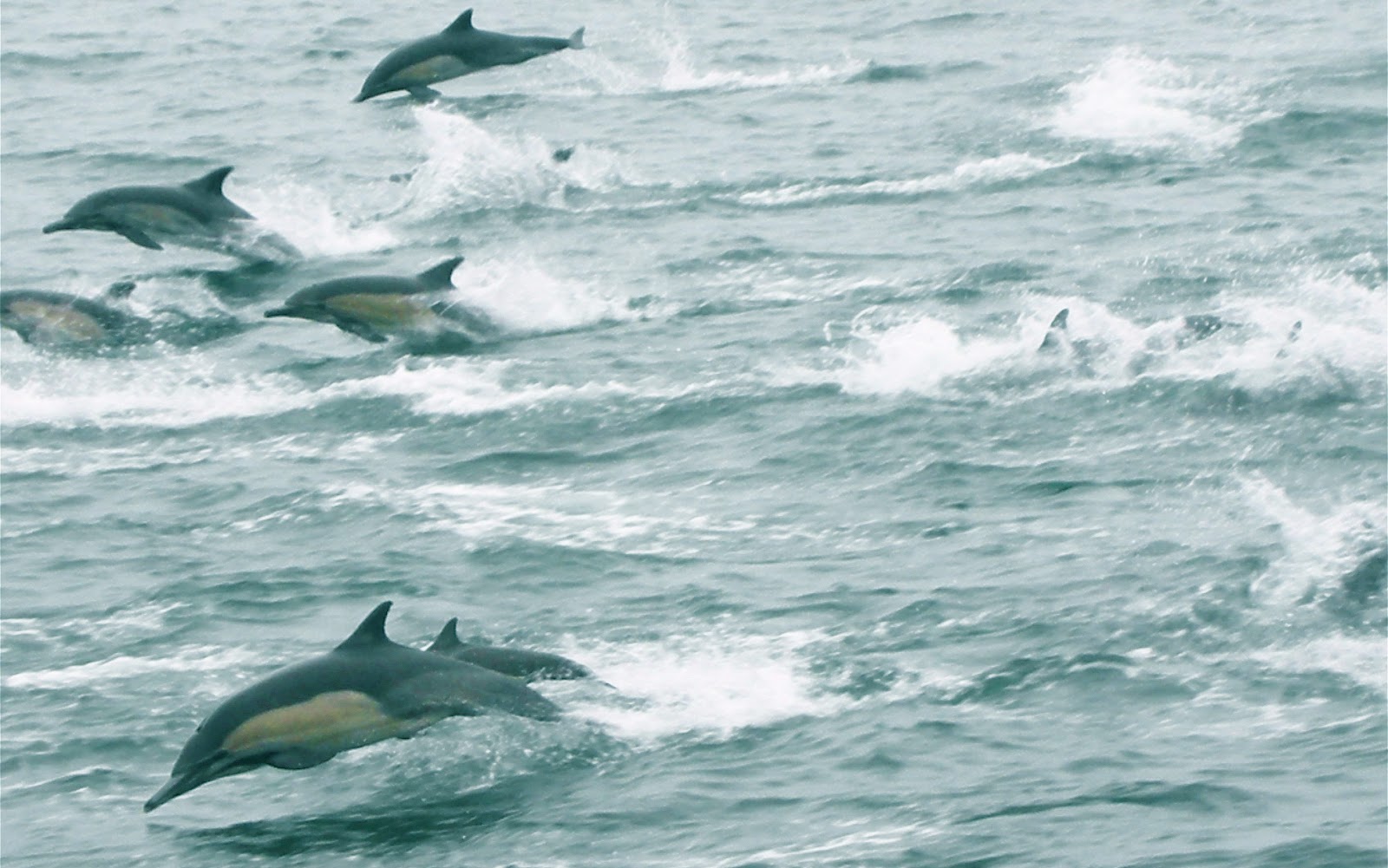
Photo by Karin Lisa Atkinson ~ Dolphins Surfing, Port of Los Angeles